
What is NMR spectroscopy?
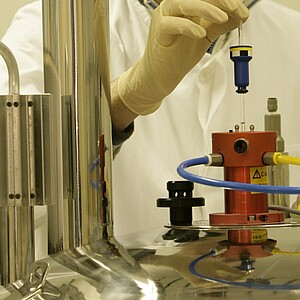
Nuclear magnetic resonance spectroscopy (NMR) is a core analytical technique for investigating molecular structures, dynamics, and intermolecular interactions. It is based on the fact that atomic nuclei with a non-zero nuclear spin adopt defined energy levels in a strong magnetic field. Short radio-frequency pulses excite these nuclear spins; as they relax back to equilibrium, they emit a measurable signal that is converted into an NMR spectrum via Fourier transformation.
The resonance frequency of a nucleus is highly sensitive to its local electronic environment, enabling precise discrimination of functional groups, neighboring atoms, and structural motifs. Modern spectrometers with superconducting magnets (300–900 MHz for 1H) provide high sensitivity and excellent resolution.
NMR spectroscopy delivers an exceptionally broad range of structural and dynamic information. It is particularly powerful for determining the three-dimensional structure of molecules: chemical shifts, coupling patterns, and 2D/3D experiments such as COSY, HSQC, HMBC, or NOESY allow the identification of functional groups, assignment of bonding relationships, and analysis of spatial proximity. This enables detailed structural characterization of both small molecules and proteins directly in solution.
Another major application is the analysis of molecular motion and dynamics. Relaxation times (T1, T2), exchange processes, and conformational changes offer insights into flexibility, folding states, and internal motions—often on timescales inaccessible to other methods.
NMR further enables the investigation of intermolecular interactions. Changes in chemical shift, NOE contacts, or titration-based experiments allow the identification of binding partners, mapping of interaction surfaces, and quantification of binding affinities. This makes it possible to precisely analyze protein–ligand, protein–protein, and protein–nucleic acid complexes.
Finally, NMR is well suited for characterizing complex mixtures. Without prior separation, components can be identified and quantified, making it ideal for metabolic analyses, natural product mixtures, reaction monitoring, or quality control. Measurements are non-destructive and often performed in near-native solution conditions.
NMR at the Institute of Chemistry and Metabolomics
At the Lübeck site, NMR is a key technology for:
Metabolomics & clinical studies
- profiling of serum, plasma, and other human samples
- identification and validation of potential biomarkers
Metabolic flux analyses
- tracing labeled metabolites in cellular models
- understanding metabolic pathways in health and disease
Protein & glycoprotein analytics
- investigation of protein–ligand interactions
- analysis of glycan structures and post-translational modifications
Method development
- NMR methods for metabolomics
- analysis of large datasets, statistical modeling, and software development (e.g. Matlab-based processing pipelines)
The platform is used for in-house research (biomedicine, chemistry, metabolomics) as well as for collaborations with clinical and external academic partners.
A detailed description of our instruments is provided in the following section.