
What is mass spectrometry?
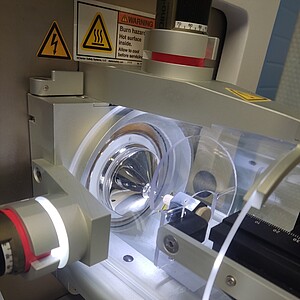
Mass spectrometry (MS) is a high-resolution analytical technique used to determine the mass, composition, and architecture of (biological) molecules. Through ionization, transfer into the gas phase, mass-to-charge (m/z) separation, and detection, MS provides precise information on small molecules, proteins, and protein complexes—up to large supramolecular assemblies such as viral capsids.
Modern MS encompasses a broad methodological spectrum:
Bottom-up MS enables the identification and characterization of proteins via their peptides; top-down MS analyzes intact proteins, including modifications and isoforms. HDX-MS (hydrogen–deuterium exchange) provides insights into protein dynamics, flexibility, and interaction surfaces.
Native MS allows the investigation of non-covalent complexes in a near-physiological state, including oligomerization, assembly pathways, and structural heterogeneity. Charge-detection MS (CDMS) extends these capabilities to very high masses in the megadalton range and highly heterogeneous particles, enabling direct mass determination of individual viral capsids, among others.
By combining these approaches, researchers can elucidate molecular structure, composition, post-translational modifications, as well as dynamic processes and assembly mechanisms in detail. This makes mass spectrometry a central tool for the analysis of complex biomolecular systems.
Mass spectrometry at the Institute of Chemistry and Metabolomics
At the Hamburg site, mass spectrometry is a core technology for the structural analysis of viral systems and complex protein assemblies. The focus lies on high-resolution, native-preserving, and dynamics-sensitive methods.
Structural & complex Analysis
- native MS and top-down MS for resolving quaternary and primary structural features
- characterization of protein complexes, assembly states, and oligomerization
- analysis of viral particles (VLPs, capsids), including heterogeneity, mass, stoichiometry, and stability
- detection of transient intermediates and coexisting conformational states
- charge-detection MS for highly heterogeneous megadalton particles
- bottom-up proteomics as a complementary approach for sequencing and PTM analysis
Dynamics & interactions
- HDX-MS for mapping local structural changes, binding interfaces, and conformational dynamics
- monitoring enzyme activity, processing steps, and structural switching in real time
- quantification of ligand binding, affinity, and effector-dependent structural changes
Method development
- integration of MS with various light sources, including PETRA III, FLASH I/II, and the European XFEL
The MS systems support projects in viral structural biology, protein complex assembly, and biophysical analysis. It is open to collaborative research and welcomes scientific partnerships that lead to joint results and publications.
A detailed description of our instruments is provided in the following section.